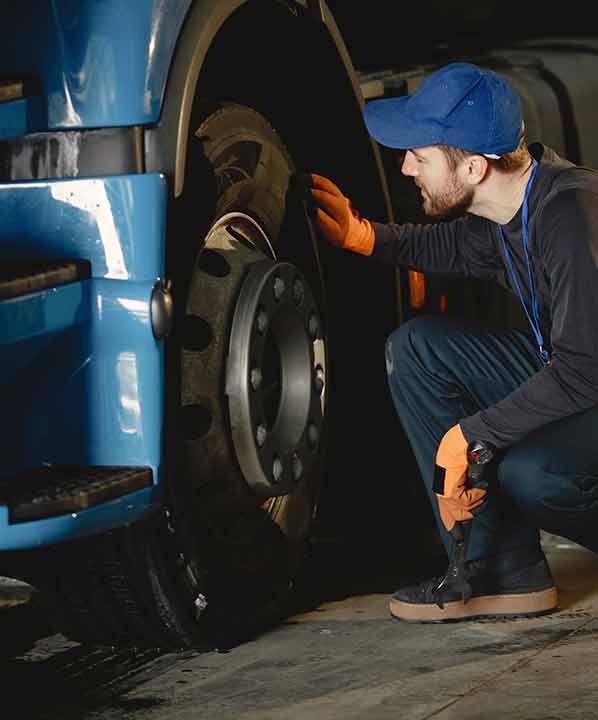
A long haul puts every tire on your rig through hours of heat, weight and highway speed. A problem you could have spotted in the yard becomes a much bigger one at mile 300, far from your home shop. Learning how to inspect semi truck tires before a long haul is one of the cheapest ways to protect your schedule, your equipment and your safety.
This routine takes about 15 to 20 minutes once you have it down. It covers the six things that strand trucks most often: pressure, tread depth, sidewalls, duals, valve stems and lug nuts. Do it the same way every time and it becomes second nature.
What You Need Before You Start
You do not need a shop full of equipment. Keep these in the cab so the check never gets skipped for lack of tools:
- A calibrated truck tire pressure gauge, preferably a dual-foot style that reaches inside duals
- A tread depth gauge that reads in 32nds of an inch
- A flashlight for inner duals and wheel wells
- Gloves and a small notebook or your fleet’s inspection app
Park on level ground, set the brakes and chock the wheels if you are working around the truck for any length of time.
Step 1: Check Air Pressure Cold
Pressure is the single most important thing you will check. Take readings cold, meaning before the truck has been driven or after it has sat for several hours. A tire that just came off the highway reads higher than it really is, which can hide a tire that is actually low.
Gauge every tire, including the inside duals that are a pain to reach. Compare each reading to the inflation your tire manufacturer’s load and inflation table calls for at the weight you are hauling. A few points of difference between dual partners matters, because the tire with more air ends up carrying more of the load.
A few rules that save tires:
- Never judge pressure by thumping the tire with a bat or mallet. It will not catch a tire that is 20 PSI low.
- Do not bleed air from a hot tire. Pressure rises as tires warm up, and that is normal.
- If one tire is repeatedly low, find the leak instead of airing it up every morning.
A tire that keeps losing air usually has a puncture, a bead leak or a bad valve core. Our tire repair services can find and fix it before it turns into heat damage on the road.
Step 2: Measure Tread Depth On Every Position
Federal rules set minimum tread depths for commercial trucks. Under FMCSA regulations, steer tires must have at least 4/32 of an inch of tread in every major groove, and tires on all other positions, including drive and trailer tires, must have at least 2/32 of an inch. Those are legal minimums, not targets. Many fleets pull tires well before they get that low, especially steer tires.
Measure in a major groove, not on a wear bar, and check several points across the tire and around its circumference. Uneven readings tell you something:
- Shoulder wear on both edges often points to underinflation or overloading
- Center wear can mean the tire has been running overinflated
- Wear on one shoulder suggests an alignment problem
- Cupping or scalloping can indicate worn suspension parts or balance issues
- Flat spots usually come from a locked-up brake or a hard skid
Note any irregular wear in your log. Catching a pattern early can save the rest of the set.
Step 3: Inspect Sidewalls For Damage
The sidewall flexes with every turn of the wheel, and damage here is the kind that fails suddenly. Walk each side of the truck with a flashlight and look closely at both the outer and inner sidewalls where you can see them.
Take a tire out of service if you find:
- A bulge, bubble or wavy spot, which signals internal separation
- Cuts or gouges deep enough to show cords or fabric
- Exposed ply or belt material anywhere on the tread or sidewall
- Deep weather cracking, especially on trailers that sit for long periods
- Signs of a curb strike, such as scuffs with a raised or distorted area
Also check the DOT date code. The last four digits give the week and year the tire was built. Older tires can look fine and still be weak, so follow your fleet’s age policy.
Step 4: Look Closely At The Duals
Duals get less attention than steers, which is exactly why they cause trouble. Spend real time on each pair.
- Check both tires’ pressure. A flat inner dual can hide behind a good outer tire for miles while its partner overloads.
- Look between the tires. Rocks, bricks and scrap can wedge in the gap and grind the sidewalls.
- Confirm the tires are not touching each other or any part of the truck.
- Match the pair. Duals should be close in diameter and tread depth. A mismatched pair forces one tire to do more work and scrub the other. Follow your tire maker’s guidance for allowable difference.
Step 5: Check Valve Stems And Caps
Valve stems are small, cheap parts that cause a surprising number of roadside calls. Look for stems that are cracked, bent or rubbing against the wheel or brake drum. On inner duals, make sure the stem or extension is secure and reachable so you can actually check pressure.
Every stem should have a cap. Caps keep dirt and moisture out of the valve core and act as a backup seal. If you hear a faint hiss or see a stem that looks off, a quick soapy water spray will show whether it is leaking.
Step 6: Inspect Lug Nuts And Wheels
A loose wheel is one of the most dangerous things that can happen on a heavy truck. Look at every wheel for these warning signs:
- Rust streaks running outward from the lug nuts, a common sign of looseness
- Shiny, polished metal around studs or nuts from movement
- Missing, damaged or mismatched nuts
- Cracks in the wheel, especially around stud holes or hand holes
- Bent rims or damaged flanges
If your fleet uses loose-nut indicators, check that they all still point in the same direction. Any sign of a loose wheel means the truck does not leave until it is corrected and torqued to spec by someone trained to do it. Our semi truck tire service includes proper mounting and torque procedures for hub-piloted and stud-piloted wheels.
Make It Routine: How To Inspect Semi Truck Tires Before A Long Haul, Every Time
A tire check only helps if you do it every trip. Write down pressure readings and tread depths so you can see trends, like a tire that loses a few PSI every day or an axle that wears faster than the rest. Share them with your dispatcher or fleet manager so repairs get scheduled, not discovered on the shoulder.
For fleets running multiple trucks, a consistent schedule makes a big difference. Our fleet tire management service helps you stay ahead of wear, pressure problems and replacements across your whole operation.
When To Call For Help
The point of learning how to inspect semi truck tires before a long haul is to catch problems in the yard. If your check turns up a bulge, exposed cords, tread below the legal minimum, a loose wheel or a leak you cannot find, fix it before you leave. Running a known problem on a long haul almost always costs more.
Tire Installation LLC has worked on trucks around Memphis for more than 30 years, with mobile service at truck yards, docks, distribution centers and along I-40, I-55 and I-240. We offer free estimates and upfront pricing. Call (866) 998-4737 to book a DOT-focused tire check or get a problem fixed before your next run.